
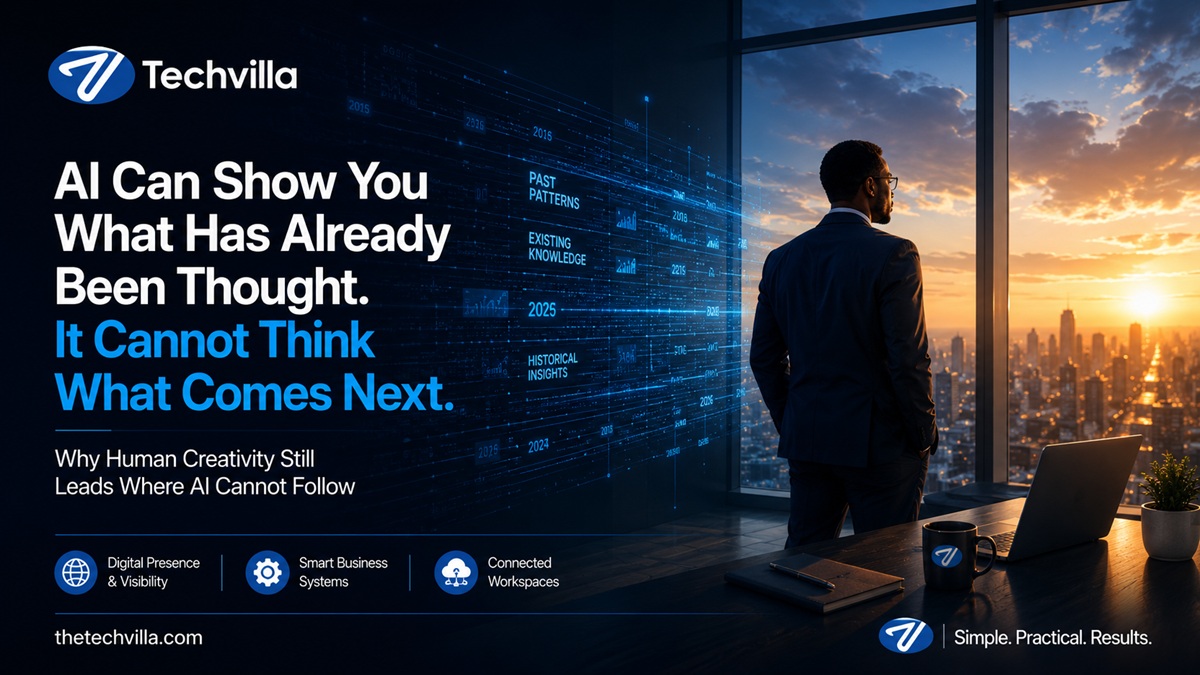
A widely shared take from a prominent Nigerian tech commentator recently captured something our AI series has been circling since the beginning, put more precisely than we had managed to say it. After an ideation session that left him unimpressed with one AI tool's recursive, circular suggestions, and only modestly more impressed with another's, he arrived at a conclusion worth sitting with: AI is genuinely excellent for understanding the boundaries of previous thinking, for surfacing whether others have already had a similar idea, but it consistently struggles the moment a task requires genuinely new association-making, the kind of forward-looking creative leap the human mind still does uniquely well. A related observation making the rounds captures the same idea even more sharply: AI is data, and data can only look backwards, while creativity looks forward.
This distinction is not just a clever turn of phrase. It is quietly the most useful lens for making sense of everything we found across law, coding, HR, therapy, and content creation in our earlier comprehensive review, and it deserves to be applied specifically to how professionals actually think, ideate, and strategise.
What the Evidence Actually Confirms About This Limit
This is not merely one person's frustration with a tool. Current analysis of AI's limitations in 2026 consistently lands on the same conclusion from multiple independent angles. Generative AI recombines patterns from its training corpus rather than producing genuinely novel ideas, a limitation researchers describe plainly as an absence of grounded creativity. A survey of art critics rated AI-generated artwork 30 percent less innovative than human-created work, a concrete, measurable gap rather than a subjective complaint.
Perhaps most tellingly, Nvidia's CEO Jensen Huang has been widely quoted making the same point from the opposite direction, that AI itself does not replace professions, but people who master it as a tool replace people who do not, precisely because the tool amplifies whatever direction a skilled person already points it toward.
The mechanism behind this is straightforward once you see it clearly. Every large language model is, fundamentally, a highly sophisticated pattern-matching system built entirely from what has already been written, said, coded, argued, or created. It can identify that a pattern exists, extend that pattern convincingly, and remix elements of it in genuinely useful new combinations. What it structurally cannot do is originate a idea that has no precedent anywhere in its training data, because there is nothing in its architecture that reaches beyond what has already happened to imagine, with genuine intent, what has not.
Applying This Lens Across the Professions We Have Already Covered
This distinction sharpens something in each profession we examined previously.
In legal practice, AI's genuine strength lies in research, precisely mapping what has already been argued, decided, and established as precedent. This is why the tools genuinely save lawyers hundreds of hours on research and document review. But the strategic judgement of how to argue a truly novel case, one without a clean precedent to draw from, remains stubbornly human, because that requires imagining an argument that does not yet exist in the historical record.
In HR, AI competently screens candidates against patterns of what has historically indicated a good hire. It cannot originate the forward-looking judgement of who might thrive in a role the organisation has never had before, in a market condition that has not occurred previously.
In software development, AI can recombine coding patterns it has seen thousands of times into working, useful code remarkably fast, which explains both its genuine productivity gains and the cost blowouts we covered previously, since heavy usage on backward-looking recombination does not automatically translate into forward-looking architectural innovation.
In content creation, this backward-looking constraint is precisely why AI-generated work is rated measurably less original by critics, and why the unresolved copyright question keeps circling back to how much genuine human creative input, forward-looking, non-derivative thinking, actually went into a given piece.
Why This Matters Most for Strategy and Ideation Specifically
Business strategy and ideation are, by definition, exercises in forward-looking thinking, imagining a market position, a product, or a solution that does not yet exist. Recent research on AI and innovation strategy makes a genuinely useful distinction here: organisations pursuing sustaining innovation, refining what already works, benefit from sequencing predictive AI first, since predictive tools excel at optimising within known patterns. Organisations pursuing genuinely novel innovation, entering new markets or inventing new categories, need to put human-led generative thinking first, using AI afterward to test, refine, and stress the idea rather than originate it.
This maps precisely onto the take that sparked this piece. AI is an excellent tool for confirming whether an idea has already been tried, for mapping the boundaries of existing thinking before you push past them. It is a poor substitute for the actual pushing.
What This Means in Practice for Nigerian Businesses
The practical implication is not to avoid AI in strategic thinking. It is to use it correctly, as a boundary-mapping and research tool that clears away what is already known, so your own forward-looking thinking has more room and more precision to operate in. Use AI to quickly establish what has already been tried in your industry, what the existing playbook looks like, and where the well-worn patterns sit. Then do the harder, more human work of imagining what falls outside that pattern, because that is precisely the part no amount of training data can do for you.
This is the same principle we opened this entire AI series with, that AI amplifies existing domain expertise rather than generating genuinely new thinking on its own. What this specific lens adds is a clearer, more precise reason why: expertise and creativity are forward-looking human capacities, built from lived experience and imagination, while AI, however capable, is fundamentally a mirror held up to the past.
At Techvilla, this is exactly the distinction we hold onto when building technology for clients. We use AI, and recommend it to clients, for what it is genuinely good at, and we never mistake backward-looking pattern recombination for the forward-looking strategic thinking that only your own expertise and imagination can provide.
Chat with us on WhatsApp or start a free consultation.
Because the goal is not just to build a website. The goal is to make your business digital, visible, and future-ready.
Need technical assistance?
I'm Techvilla Admin. We help businesses move from offline to online with simple, clear steps. If you have questions about this article or need help with your project, let's chat.