
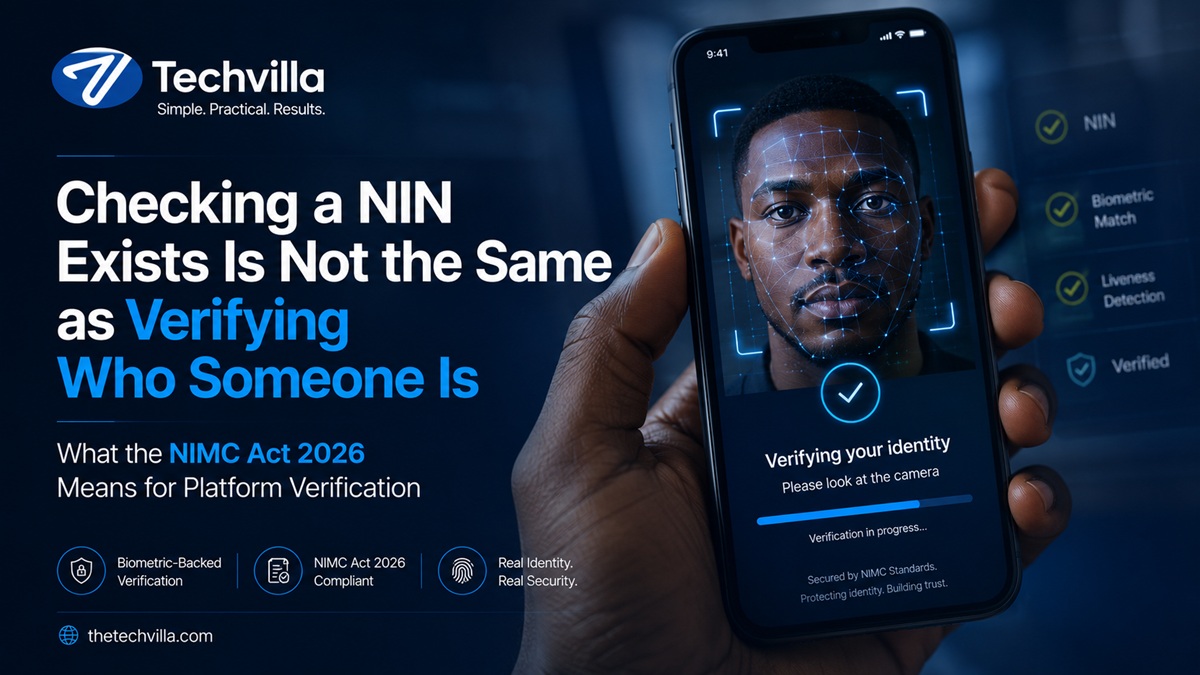
Nigeria's identity infrastructure changed in a fundamental way this year, and the implications are still unfolding across every platform that touches customer verification. President Bola Ahmed Tinubu signed the National Identity Management Commission Act 2026 into law in June, replacing a framework that had gone unchanged since 2007, back when Nigeria had no biometric database at scale and linking an identity number to a bank account still sounded like science fiction. That Act is now actively being operationalised, and the practical standard for what counts as genuine identity verification in Nigeria has quietly moved beneath the feet of any platform still doing this the old way.
What the NIMC Act Actually Establishes
The Act designates NIMC as the Root Certification Authority for Nigeria's National Public Key Infrastructure and Digital Public Infrastructure, taking over responsibilities previously held by NITDA. In practical terms, this means NIMC now controls the digital trust structure that every online transaction, encrypted document, and secure identity check in Nigeria will eventually rely on. The Act also enshrines a principle of one person, one identity, formally recognises both physical and digital NIN-linked credentials, and introduces tougher penalties specifically for multiple registrations and identity-related fraud.
None of this is abstract policy detail. It establishes the National Identification Number as the foundational credential that all digital identity verification in Nigeria is now expected to build on, not one option among several.
Why Collecting a NIN Is Not the Same as Verifying One
This is the distinction most platforms have not fully absorbed yet, and it is worth being precise about, because the standard has changed on this specific point.
Storing a NIN in a database is data collection. Checking that a NIN exists in NIMC's records is a lookup. Neither of these confirms that the person currently sitting in front of a screen, submitting that NIN during onboarding, is actually the person the NIN belongs to. That confirmation, the actual verification, requires biometric matching: comparing a live selfie against the photo tied to the NIN record, and running liveness detection to confirm a real person is present rather than a photograph, a video replay, or an increasingly sophisticated deepfake.
This is not a theoretical concern in Nigeria today. Criminal groups are actively using generative AI to produce synthetic identities and bypass biometric verification tools, deploying deepfake videos specifically to defeat liveness checks during remote onboarding. Fraudsters using stolen NINs paired with fabricated faces are a real, documented threat, not a hypothetical risk analysts are speculating about.
The Central Bank of Nigeria's own 2026 baseline standards make the shift explicit. Under the mandatory three-tier KYC framework now in force, self-declaration alone no longer satisfies any tier, and BVN and NIN verification must happen through automated, real-time lookups against NIBSS and NIMC records, not manual checks performed after the fact. Tier 1 requires BVN or NIN linkage for lower transaction limits, Tier 2 requires a verified government ID and address for higher limits, and Tier 3 requires full beneficial ownership verification with no transaction ceiling at all. The bar rises with the risk, but at every tier, a basic lookup is explicitly no longer enough.
What This Means for Software and Platform Development
For any startup or organisation building a platform that onboards users in Nigeria, whether that is a fintech, an e-commerce marketplace, a logistics platform, or a professional services portal handling sensitive client data, identity verification can no longer be treated as a simple form field asking someone to type in their NIN. It needs to be engineered as proper infrastructure.
This means integrating with NIMC and NIBSS through legitimate, automated verification channels rather than relying on manual or one-off checks. It means building biometric confirmation into the onboarding flow itself, live selfie capture matched against the NIN record, with genuine liveness detection capable of catching video replays and increasingly convincing deepfakes, not just a basic "smile for the camera" step that a determined fraudster can defeat. It means designing tiered verification that matches the level of assurance to the level of risk, a low-value transaction does not need the same verification depth as a high-value one, but the system needs to be built to scale that assurance automatically as risk increases. And it means keeping a clear, auditable trail of exactly what was checked, when, and against which record, because regulators increasingly expect platforms to demonstrate this, not merely claim it.
There is also a data protection dimension that cannot be separated from this. Biometric data collected during verification is sensitive personal data under the Nigeria Data Protection Act, and the NDPC's 2026 enforcement wave makes clear that how this data is stored, secured, and who has access to it carries real regulatory consequences. A platform that builds strong verification but weak data protection around the biometric information it collects has simply traded one compliance risk for another.
What Startups and Organisations Should Actually Do Now
Getting ahead of this starts with an honest technical audit. Does your current onboarding flow perform a genuine biometric match, or does it simply check that a NIN number exists in a database? Is liveness detection actually built in, or is there a gap a determined fraudster using a deepfake could walk through? Is verification depth tiered to transaction risk, or is every user, regardless of what they are doing on the platform, running through the same shallow check?
Platforms that answer these questions honestly and find gaps are not necessarily behind through any fault of their own. Verification requirements have moved quickly, and building this properly requires software engineering expertise specifically focused on identity infrastructure, not a checkbox added to an existing signup form. The platforms already treating verification as serious infrastructure, with automated real-time lookups, genuine biometric and liveness confirmation, and clear audit trails, are already positioned ahead of where the regulatory bar currently sits. The ones still running on basic lookups are now operating behind a standard that has already moved past them, whether or not they have noticed yet.
Where Techvilla Fits Into This
This is precisely the kind of technical challenge that belongs in custom software development and IT consulting, not a policy memo to be filed away and forgotten. Building verification infrastructure that genuinely holds up, technically sound, properly integrated with Nigeria's identity systems, and compliant with data protection obligations around the sensitive data it collects, requires the same disciplined approach we have described throughout this series: understanding the actual regulatory requirement, building for Nigeria's specific operating and fraud environment, and never treating compliance as an afterthought bolted onto a finished product.
At Techvilla, we help Nigerian startups and organisations build identity verification and platform infrastructure that meets Nigeria's current standards properly, from biometric confirmation to secure handling of the sensitive data that verification depends on.
Chat with us on WhatsApp or start a free consultation.
Because the goal is not just to build a website. The goal is to make your business digital, visible, and future-ready.
Need technical assistance?
I'm Techvilla Admin. We help businesses move from offline to online with simple, clear steps. If you have questions about this article or need help with your project, let's chat.