
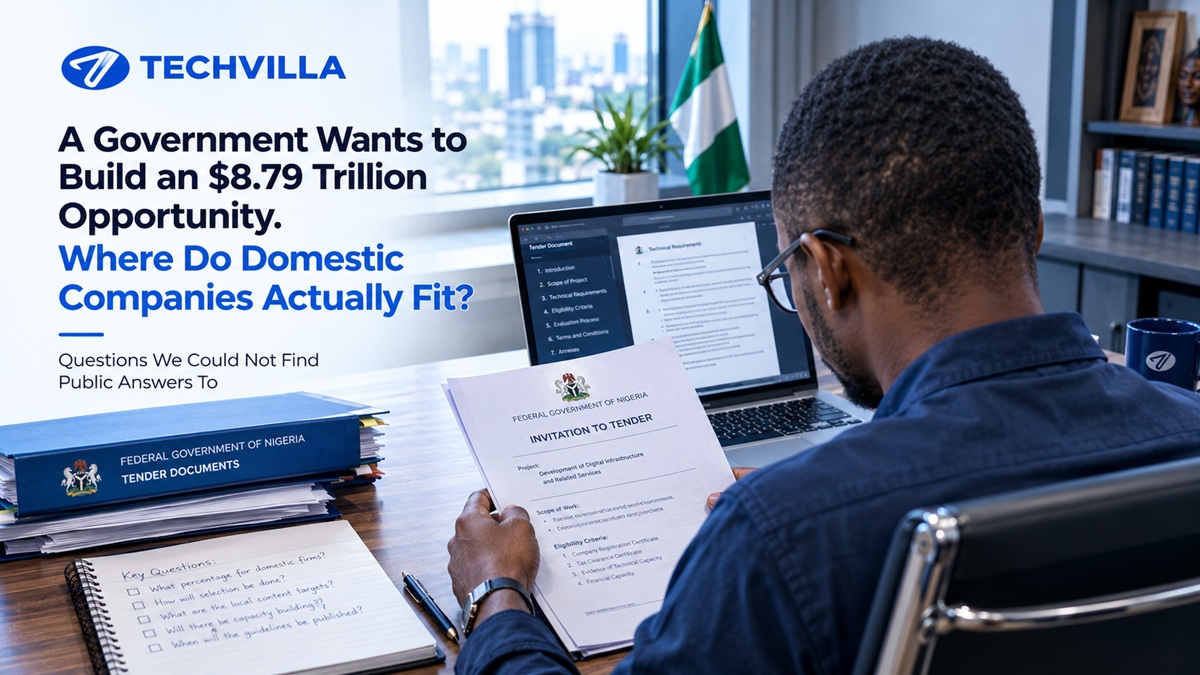
There is a government-backed website (otni.gov.ng) built around a genuinely exciting proposition: Nigeria wants to become one of the world's preferred outsourcing destinations, target a meaningful slice of the $8.79 trillion global BPO and IT-enabled services market, and create up to 5 million jobs by 2030. It talks about world-class BPO centres being built across all six geopolitical zones. It talks about "robust technology infrastructure" and "fully managed office services". It even has an active government tender open right now for a consultancy to help build the whole thing out. On paper, this should be exactly the kind of national initiative a Nigerian technology company gets genuinely excited about.
So we spent some time digging through it properly, the official site, the launch coverage, the government statements, the open tender documents, and came away with more questions than answers. That gap itself is what we feel worth writing about honestly, rather than pretending we had it all figured out.
What We Could Confirm
The Outsource to Nigeria Initiative, OTNI, is a real, actively running public-private partnership, launched in March 2024 by the Vice President's office, structured around three pillars: the government as "anchor", a private outsourcing company called Outsource Global as the operational driver, and a digital platform called Worknation matching talent to opportunities. The ambition is large and specific: BPO-ready regional centres in every geopolitical zone, "plug-and-play" infrastructure for international and domestic BPO companies, and a stated goal of capturing meaningful revenue and job creation from a global industry currently dominated by India and the Philippines.
As of this month - September 2026 - there is an open Expression of Interest, funded through the Bank of Industry under the iDICE Programme, seeking a consultancy specifically to help establish this national BPO industry, closing in late October 2026.
What We Could Not Find, Despite Looking
Here is where things get genuinely unclear - There is no published criteria anywhere we could locate for how a domestic Nigerian company, technology provider, infrastructure vendor, or otherwise, actually gets involved with OTNI beyond simply existing as a registered Nigerian business. The site describes plans for regional centres requiring serious "technology infrastructure" and "fully managed office services", precisely the kind of work Nigerian companies building office networks and managed IT support already do daily, but there is no vendor registration page, no procurement portal, no published requirements document, and no clear contact route beyond a general info email.
This raises a set of honest questions we genuinely do not have confident answers to, and think are worth asking out loud.
Who actually builds these regional centres, and how does a Nigerian infrastructure or technology company get considered? Is this an open, competitive procurement process, something closer to how the iDICE consultancy tender was published publicly, or is it being arranged through direct relationships between the anchor partners and select contractors, with no public entry point for anyone else?
What does "domestic BPO" participation actually look like beyond talent supply? The initiative language repeatedly emphasises Nigeria's talent pool, its English-speaking, young, educated workforce, as the core value proposition, which is a genuine strength. But an outsourcing industry built purely around labour supply, with the actual infrastructure, technology, and higher-value service contracts flowing to a smaller set of anchor private-sector partners, is a very different opportunity for the average Nigerian tech company than one where domestic firms can genuinely bid for infrastructure, software, and service delivery contracts as the centres get built.
Is there a registration or partnership process at all for companies outside the initial anchor partnership? We could not find one. That does not mean it does not exist, initiatives like this often run more relationship-driven processes in their early phase before formal public procurement channels open up. But it does mean a company genuinely interested in participating currently has to ask directly, rather than simply applying somewhere.
How does a company find out when and where the actual work becomes available? Beyond the one live iDICE tender we found, there is no visible pipeline of upcoming opportunities, no public roadmap of which zone gets its centre built first, and no indication of whether smaller domestic vendors will be invited to bid on specific pieces of that work as it happens, networking, hardware, custom software, or whether that work stays entirely within Outsource Global's own operational structure.
Why It Is Necessary to Ask Publicly, Not Just Privately
Initiatives like OTNI are genuinely good news for Nigeria's broader digital economy narrative, and the ambition behind them deserves real credit. But ambition stated publicly and access explained publicly are two different things, and the gap between them is exactly where good opportunities quietly become good opportunities for a small number of well-connected firms instead. Nigerian technology companies watching this space have every right to ask, plainly and without cynicism, how does a business outside the initial partnership actually get in the door?
We do not have that answer yet. We are genuinely curious, and we think other Nigerian technology companies reading this should be too, rather than assuming the opportunity will simply find them once the centres are built.
If you have looked into OTNI more closely, been in contact with the initiative directly, or know something about the actual partner or vendor pathway we could not find publicly, we would genuinely like to hear it. This is one of those rare posts where we are more interested in what the comments teach us than in what we already wrote.
At Techvilla, we build exactly the kind of infrastructure and technology this initiative says it needs, and we would rather ask the honest question in public than assume our way into an answer.
Chat with us on WhatsApp or start a free consultation.
Because the goal is not just to build a website. The goal is to make your business digital, visible, and future-ready.
Need technical assistance?
I'm Techvilla Admin. We help businesses move from offline to online with simple, clear steps. If you have questions about this article or need help with your project, let's chat.