
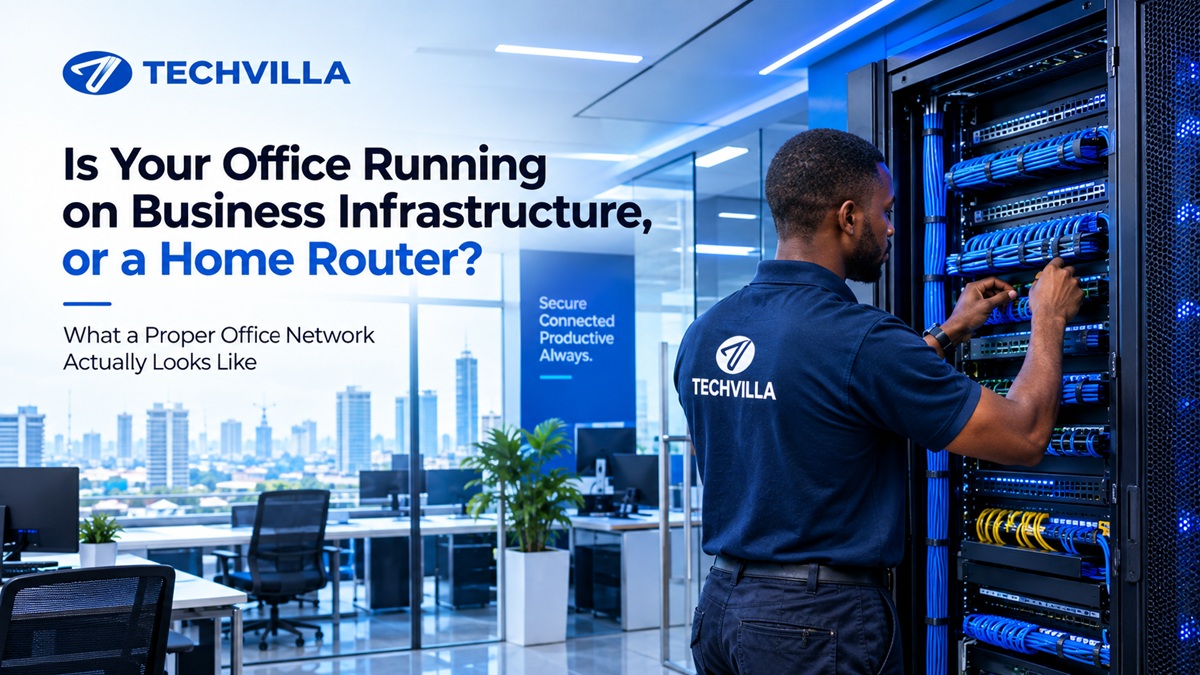
If your office runs on a single Wi-Fi router shared between everyone, staff, guests, printers, and whatever device happens to connect first, you are running your business on a home setup, not a business network. You need to know that distinction matters more than it sounds. An office network is the structured system of routers, switches, cabling, and access points that connects every device, computer, printer, phone system, and server, in your workplace into one properly managed, secure, and reliable system. It is the invisible infrastructure that determines whether your team's day runs smoothly or grinds to a halt every time two people try to use the internet at once.
Why This Question Matters More Than Most Nigerian Businesses Realise
Small and medium enterprises contribute almost 50 percent of Nigeria's GDP and provide more than 80 percent of employment, yet 96 percent of Nigerian businesses operating as SMEs still face real infrastructure constraints that limit productivity and growth. A significant part of that constraint sits inside the office itself, not just at the level of national broadband policy. As Nigeria's broadband expansion accelerates, with mobile data traffic climbing past 1.66 million terabytes in a single month and businesses increasingly dependent on cloud tools, digital payments, and remote collaboration, the gap between a business running on a proper office network and one running on an unstructured home setup is widening fast.
Industry technology providers are actively responding to this gap. Huawei's recent Nigeria technology showcase specifically highlighted intelligent office networking as one of the core scenarios Nigerian SMEs need addressed, alongside intelligent store, hotel, and education networks, a clear signal that structured office connectivity has moved from a nice-to-have to a recognised business necessity across the industry.
What Actually Makes Up an Office Network?
An office network is not just "having Wi-Fi". It is a structured system built from several distinct components working together. Business-grade routers and switches handle the actual traffic flowing between devices, built to manage far more simultaneous connections than a basic home router was ever designed for. Access points placed strategically throughout your office ensure consistent, strong signal in every room, not just near the router. Structured cabling connects desktop computers, printers, and other fixed equipment directly and reliably, reducing dependency on wireless signal for critical, stationary devices. And network security measures, firewalls, access controls, and monitoring protect your business data from unauthorised access, both from outside threats and from unmanaged internal access.
Each of these pieces exists for a reason. Remove any one of them, and the whole system becomes noticeably weaker, even if the parts that remain are individually working fine.
The Piece Most Businesses Miss: Controlling Who Actually Gets On the Network
Cabling, routers, and access points solve the "can devices connect" problem. They do not solve a different, equally important question: who should be allowed to connect, when, and with how much access.
This is precisely where LANCore, Techvilla's network gateway platform, fits into an office network rather than sitting apart from it. Instead of one shared password every staff member, visitor, and vendor eventually learns, LANCore lets each staff member log in with individual credentials, gives management visibility over who accessed the network and when, and presents a branded login page rather than a generic router screen. Guests and visitors can be given time-limited access that expires automatically, so nobody has to remember to revoke a password after a vendor's visit ends. For an office handling sensitive client information, particularly relevant given Nigeria's tightening data protection standards, this kind of access control turns a network from a convenience into something you can actually account for if you ever needed to.
This is not a separate product bolted onto your network. It is the access-control layer a properly designed office network should already include, and most Nigerian offices running on a basic shared router simply never had.
Does Your Business Actually Need One?
Not every business needs the same level of network infrastructure, but there are clear signals worth paying attention to. If more than a handful of staff members regularly rely on the internet to do their jobs, checking email, using cloud-based software, processing digital payments, a basic home router setup is very likely already costing you more in daily frustration and lost time than a proper network would cost to install.
If your office handles sensitive customer or business data, an unsecured, unmanaged network is a real and growing liability, not just an inconvenience. And if guests, clients, or vendors regularly need internet access in your space, sharing your staff network with visitors is both a performance problem and a genuine security risk, exactly the kind of gap individual guest credentials are built to close.
What Happens When Businesses Skip This Step
Most Nigerian businesses do not deliberately decide to run on a home-grade network. It simply happens by default, someone plugs in a router when the office opens, it works well enough at first, and nobody revisits the decision as the business grows. The costs of this default choice tend to be invisible individually and significant cumulatively: staff quietly losing minutes here and there to slow or dropped connections, sensitive files shared insecurely because there was never a proper structure for controlling access, and a single point of failure, one router, one connection, with no redundancy if something goes wrong at a critical moment.
Getting This Right From the Start
A properly designed office network does not need to be complicated or prohibitively expensive to be genuinely effective. What it needs is deliberate planning around your specific space, your actual number of devices and users, and how your business handles security and guest access. Reliable, secure connectivity built for Nigerian power and operating conditions also needs to account for realities most generic setups ignore entirely, frequent power interruptions, the switch between grid power and backup generators, and the performance demands of a growing, increasingly cloud-dependent business.
Getting your office network right in Nigeria starts with treating it as real business infrastructure, not an afterthought handled once and forgotten.
At Techvilla, we design and install office networks specifically for business environments, properly planned, professionally secured with LANCore's access control where it matters, and built to keep your team working reliably as your business grows.
Chat with us on WhatsApp or start a free consultation.
Because the goal is not just to build a website. The goal is to make your business digital, visible, and future-ready.
Need technical assistance?
I'm Techvilla Admin. We help businesses move from offline to online with simple, clear steps. If you have questions about this article or need help with your project, let's chat.