
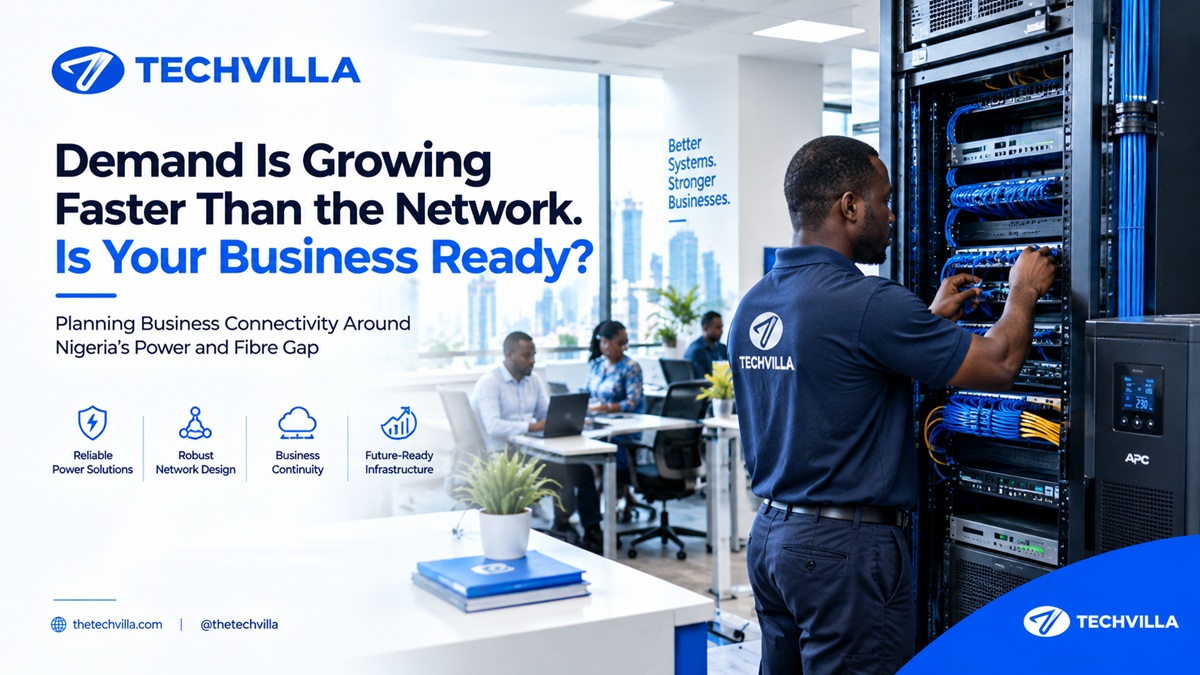
Nigerians used about 1.6 million terabytes of data in July 2026, almost 47 percent more than a year earlier, and the regulator itself says the networks carrying that traffic are struggling to keep pace. For any business that depends on the internet, this is not just a policy story. It is a planning story. Here is what the NCC's Digital Connectivity Investment Forum concluded, what is only proposed so far, and how to plan your own business connectivity around the gap.
What Did the NCC Digital Connectivity Forum Conclude?
The Nigeria Digital Connectivity Investment Forum 2026 was held in Abuja on September 29 and 30, convened by the NCC with Swedfund and Ookla. It brought together investors, operators, tower and fibre companies, and equipment manufacturers.
The headline numbers are striking. Subscriptions are projected to grow from about 195 million to around 350 million over the next 10 to 15 years, driven partly by cloud computing and AI. Mobile broadband coverage reaches about 90 percent of Nigerians, yet broadband penetration sits at 57.4 percent against a national target of 70 percent, and smartphone ownership is only about 27 percent. Telecoms already contributed 9.72 percent of real GDP in the second quarter of 2026, according to SBM Intelligence, so the stakes are not small.
Why Are Power and Fibre the Real Bottlenecks?
The forum named several constraints, and they are linked rather than separate.
Power. Telecom sites need reliable electricity, and outside major cities that is often the weakest link.
Middle-mile fibre. This is the fibre that connects major networks to local access points. Where it is missing, coverage exists on paper but service does not reach people properly.
Financing. The communiqué made a pointed observation: digital infrastructure lasts 20 to 30 years but cannot be financed on five-year bank loans. That mismatch makes expansion expensive.
Right of Way charges. These are the fees for laying fibre along roads and land, and they vary between states. The forum urged states to harmonise them and shorten approval timelines.
To address the fibre gap, participants called on the Federal Government to accelerate Project BRIDGE, a proposed 90,000-kilometre national fibre backbone. They also asked the NCC to finalise its framework for direct-to-device services, the satellite-to-phone technology we looked at when comparing Starlink with MTN FibreX.
What Is Actually Promised, and What Is Only Proposed?
This distinction matters for any business planning ahead. The communiqué recommends, for example, securing funding within six months for community-owned rural networks powered by renewable energy, and establishing a financing framework for telecom power within 18 to 24 months. The NCC said it would continue engaging stakeholders.
Those are recommendations from a forum, not funded commitments with delivery dates. The sensible reading is that the right problems have been named in public, which is genuinely useful, but that improvements will arrive over years. If you are planning the next 12 months of your business, you cannot count on them landing in time.
What Does This Mean for Your Business Connectivity?
If demand keeps outrunning supply, congestion and outages are not going away soon. Here is how to plan around that.
Do not depend on a single link. Where fibre reaches your street, it is usually the cheapest and best option. Pairing it with a backup, a second provider or a mobile or satellite connection, keeps you working when the main line fails. Where fibre does not reach, satellite is already a real option.
Protect your equipment from power switching. Power is the binding constraint, so assume interruptions. Network equipment that survives the switch between grid and generator keeps your office online, which is part of fixing office Wi-Fi properly.
Keep internal work off the internet. Chat, file sharing, and task tracking between staff in the same building do not need an outside connection. An offline productivity system means a congested or dead connection does not stop your team coordinating.
Control who uses your connection. When bandwidth is scarce, unmanaged use by staff and visitors hurts everyone. A properly structured office network lets you decide who connects and for how long.
Design for customers who are not on fast data. With smartphone ownership at about 27 percent, many of your customers are on basic phones or limited data. Lightweight web pages, WhatsApp, and USSD-friendly options where they fit reach people that a heavy app never will.
Is This Good News or Bad News?
Both. It is good that the regulator, investors, and operators are naming the real constraints in public, including the unglamorous ones like financing tenor and power. It is also a reminder that delivery takes years. The businesses that cope best are not the ones waiting for the national network to improve. They are the ones that build resilience into their own setup now.
Getting business connectivity right in Nigeria starts with designing for the infrastructure you have, not the one in the communiqué.
At Techvilla, we design office networks and connectivity around Nigerian power and internet realities, with backup links, protected equipment, and offline-capable systems, so a weak connection does not become a stopped business.
Chat with us on WhatsApp or start a free consultation.
Because the goal is not just to build a website. The goal is to make your business digital, visible, and future-ready.
Need technical assistance?
I'm Techvilla Admin. We help businesses move from offline to online with simple, clear steps. If you have questions about this article or need help with your project, let's chat.