
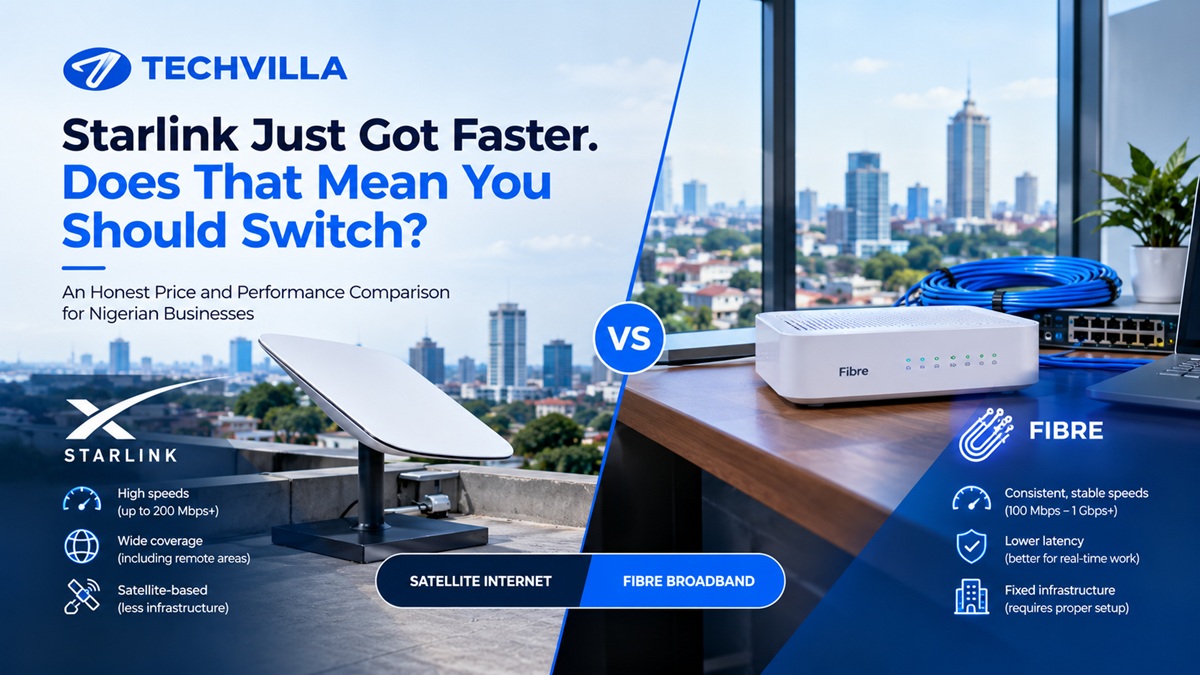
A viral post has been making the rounds claiming Starship's recent successful orbital flight, and the next-generation Starlink satellites it deployed, spells the beginning of the end for Nigerian telecom operators. The technology milestone behind that claim is real. The conclusion is not, at least not yet, and definitely not the way it's being framed. If you're a business owner wondering whether to rip out your current internet setup and switch to Starlink, here's an honest, numbers-based answer.
What Actually Happened, Stripped of the Hype
SpaceX's Starship rocket reached Earth orbit for the first time in September 2026, successfully deploying 26 next-generation Starlink V3 satellites. The technology genuinely is a significant leap, each V3 satellite is designed to deliver roughly 1 terabit per second of downlink capacity, more than 10 times the current V2 generation, and SpaceX plans to eventually launch batches of up to 60 satellites per Starship flight once the cadence matures. That last detail matters: 26 satellites reached orbit, not 60, and building genuinely comprehensive global coverage still requires many more launches beyond this one milestone.
What Starlink Actually Costs in Nigeria Right Now
As of 2026, Starlink's hardware kit runs between ₦590,000 and ₦669,000 as a one-time purchase, with monthly subscriptions ranging from ₦57,000 to ₦75,000 for residential unlimited plans, and business priority plans starting from ₦159,000 per month. In high-demand areas like parts of Lagos and Abuja, Starlink has repeatedly paused new residential orders entirely due to network congestion, meaning even businesses willing to pay can end up on a waitlist.
What the Alternative Actually Costs
MTN's FibreX, the fibre broadband service we discussed in an earlier piece on what MTN is really betting on for the long term, offers genuinely unlimited plans with no throttling and no fair usage cap, starting at ₦10,000 monthly for 10Mbps and scaling up to ₦100,000 for 300Mbps, with installation typically free where fibre coverage already exists. For a small business needing solid, reliable speeds in the 50 to 100Mbps range, that lands somewhere between ₦25,000 and ₦50,000 monthly, with zero hardware cost upfront.
The Honest Comparison
The honest takeaway from the numbers alone: where MTN FibreX already reaches your street, it is currently the cheaper, more cost-effective option for a business that just needs solid, unlimited home or office broadband. Starlink's real advantage shows up specifically where fibre infrastructure does not exist at all, rural operations, remote sites, businesses genuinely underserved by terrestrial infrastructure, not as a blanket replacement for existing, working fibre connections in serviced areas.
Why "Telcos Are Finished" Misses How This Actually Works
The viral claim assumes satellite internet simply bypasses telecom operators entirely. In practice, the more advanced satellite-to-phone technology Starlink is building, the kind that lets an ordinary smartphone connect directly to a satellite, is being rolled out in partnership with existing mobile carriers in other markets, not as a replacement for them, because those carriers hold the regulated spectrum licenses the service legally needs to operate. Starlink itself operates in Nigeria under an NCC license, inside the same regulatory framework MTN and Airtel already answer to, not outside it.
There's also a strategic reality worth remembering from our own look at where MTN is actually investing. A company racing to make fibre broadband its single biggest capital priority, while building fintech and enterprise cloud infrastructure at the same time, is not behaving like a business bracing for irrelevance.
What This Means for Your Business Decision Today
If fibre already reaches your office and gives you reliable, unlimited speeds, switching to Starlink right now would likely mean paying more for a comparable or lower-priority tier of service, unless your priority is portability or redundancy rather than raw cost. If your business operates somewhere fibre genuinely cannot reach, a construction site, a rural branch, a location with no existing infrastructure, Starlink is a genuinely strong option today, not a future promise.
The smarter question for most Nigerian businesses isn't "should I switch everything to Starlink?" It's whether your current office network setup is actually built to take advantage of whichever provider makes sense for your specific location and needs, without betting your entire operation on a single connection, satellite or fibre, ever again.
At Techvilla, we help businesses design connectivity that fits their actual location and needs, whether that means fibre, satellite, or a resilient setup that doesn't depend entirely on one provider.
Chat with us on WhatsApp or start a free consultation.
Because the goal is not just to build a website. The goal is to make your business digital, visible, and future-ready.
Need technical assistance?
I'm Techvilla Admin. We help businesses move from offline to online with simple, clear steps. If you have questions about this article or need help with your project, let's chat.