
On October 1, 2026, every addressable building in Nigeria began receiving a precise 11-character digital address. The National Digital Alphanumeric Postcode System, launched by NIPOST under Minister Bosun Tijani's Ministry of Communications, Innovation and Digital Economy, replaces the broad, imprecise six-digit postal codes Nigeria has used since 1986 with something far more exact, a code that identifies one specific building, not an entire district. If you run a business in Nigeria, particularly one involving deliveries, customer addresses, or location data in any form, this is worth understanding properly, not just skimming past as another government announcement.
Why This Exists in the First Place
Nigeria's old postal code system was never built for precision. A six-digit code like 460100 could cover an entire neighbourhood or district, telling a courier roughly where to go but never exactly where to stop. The practical result has been a country where "no address" or "vague address" is one of the most common reasons deliveries fail entirely. The government estimates Nigeria loses between ₦50 billion and ₦80 billion annually to missed and failed deliveries caused specifically by poor addressing, a staggering number for a problem that sounds, on the surface, almost mundane.
The new system was built to close that gap directly. It is Geographic Information System enabled, meaning every single postcode is tied to real, precise map coordinates, not just a general area description. NIPOST describes it as the first GIS-enabled, building-level addressing system on the African continent.
The part worth understanding properly is: how the 11-character code actually works, because the structure is more logical than the raw code first appears.
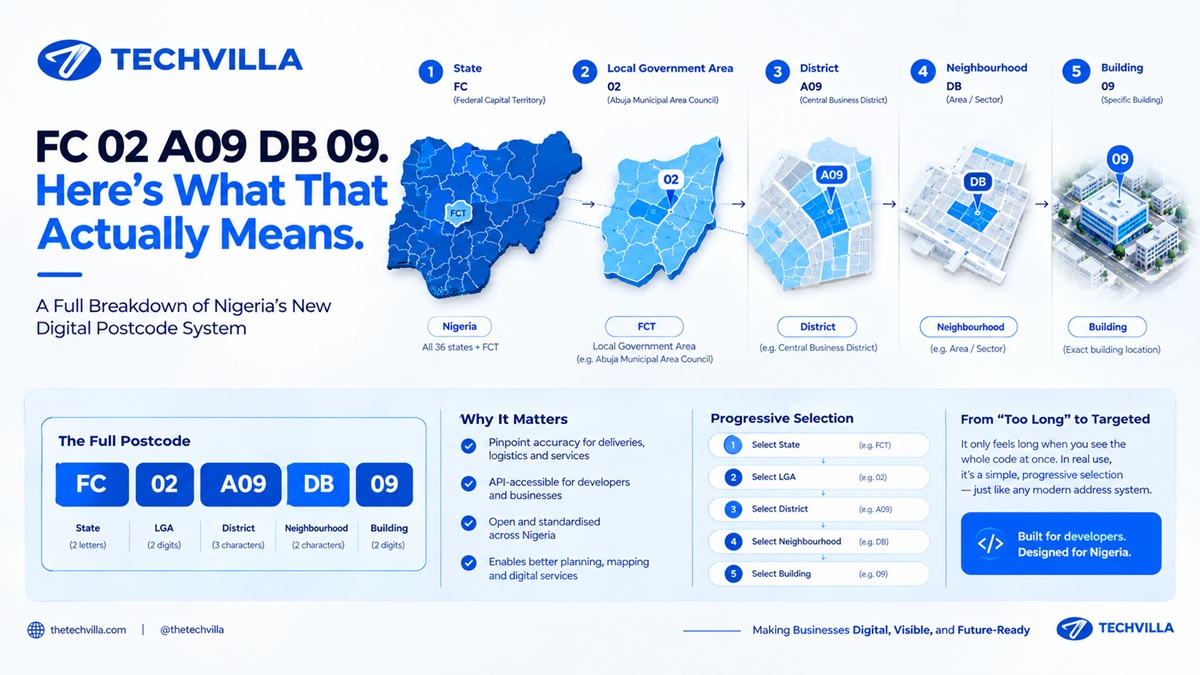
Take the example code FC 02 A09 DB 09. Read left to right, it narrows progressively from the broadest location down to one specific building, in five distinct segments.
The first segment, two letters, identifies the state or the Federal Capital Territory. FC stands for Abuja, and each of Nigeria's 36 states has its own two-letter code. The second segment, two numbers, narrows this down to the Local Government Area within that state. The third segment, three alphanumeric characters, identifies the specific district within that LGA. The fourth segment, two letters, narrows further to a defined area within that district. And the fifth and final segment, two numbers, identifies the individual building within that area.
So FC 02 A09 DB 09 reads as: Federal Capital Territory, Local Government Area 02, District A09, Area DB, Building 09. Five layers, each one narrowing the location further, until you land on one specific physical structure. The postcode is designed to sit alongside your existing street address, not replace it outright, and importantly, it identifies a building, not a person, which keeps it conceptually separate from Nigeria's identity verification systems like NIN.
Addressing the "11 Characters Is Too Long" Complaint Directly
This is a fair criticism of the raw code in isolation, and it's worth engaging with honestly rather than dismissing it. Nobody wants to memorise or manually type an 11-character alphanumeric string every time they check out on a website or confirm a delivery address.
But this complaint misunderstands how the system is actually meant to be used in a real product. The official Postcode API is explicitly built for segment-aware autocomplete and location search, meaning a properly built checkout form or delivery app never asks a user to type the whole code from scratch. The real experience looks like a progressive selection: pick your state from a dropdown, which narrows the possibilities to two letters. Pick your Local Government Area, narrowing further. Pick your district, then your area. By the time a user reaches the final segment, identifying their specific building, they are typically choosing from a short, already-filtered list or typing two or three characters, not memorising eleven.
In other words, the length of the raw code is a non-issue for anyone interacting with it through a well-built interface, the complaint is really about the unfinished state of the current user-facing tools, not a flaw in the underlying system itself. This distinction matters enormously for how businesses should think about adopting it.
The Government Is Explicitly Asking Developers to Build on This
This is the part that separates this story from most regulatory or policy news. Minister Tijani has been direct and specific: his office will work with NIPOST, government agencies, businesses, and the technology community to embed the postcode system into existing products and services, and he has publicly called on developers and innovators to propose new ways the postcode can support products across commerce, transportation, healthcare, agriculture, emergency response, and community services.
The access mechanics are already real and documented. Organisations seeking to integrate the postcode system create a developer account, submit Know Your Business documentation, and request an appropriate API access level. The API itself offers three core functions: Search (autocomplete and nearby-location lookup), Lookup (resolving a full postcode into graded address and building details), and Assembly (validating and constructing postcode structure). Search and basic Lookup are free; deeper lookup tiers require an API key and consume credits, tiered under National Data Protection Commission oversight with public, restricted, and security-only access levels.
What a Nigerian Business Could Actually Build With This
For an e-commerce or delivery business, integrating postcode lookup directly into checkout means verified, precise delivery addresses instead of vague, descriptive directions, "second house after the blue gate", directly attacking the failed-delivery problem the system was built to solve. For a logistics or transport company, this becomes a shared location layer multiple systems can plug into consistently, rather than every platform building its own imprecise address-matching logic in isolation. For a fintech or bank, the same postcode data strengthens customer address verification as part of broader KYC obligations, alongside the identity verification standards we've already covered under the NIMC Act. For a healthcare or emergency-response platform, a precise building-level address can be the difference between help arriving at the right door and help arriving somewhere nearby and guessing.
This also matters directly for a business like ours. A platform like UPshop, built for Nigerian traders selling online, stands to benefit meaningfully from precise, verified delivery addresses at checkout, exactly the kind of practical, unglamorous improvement that quietly reduces lost sales and customer frustration.
What's Still Genuinely Unfinished
Fairness requires naming this directly: the full developer portal businesses will eventually use to integrate the postcode system into their own apps is, by NIPOST's own admission, still being finalised. Right now, NIPOST is primarily collecting expressions of interest from startups, enterprises, and government agencies rather than running a fully mature, self-service onboarding flow. NIPOST's own leadership has flagged adoption, not the underlying technology, as the bigger risk, the system only creates real value if citizens, banks, logistics companies, and platforms actually use it consistently, which is a behavioural and integration challenge as much as a technical one.
This is worth taking as encouragement rather than discouragement. Early infrastructure like this tends to reward the businesses that start exploring integration now, while the ecosystem is still forming, over those who wait until it's fully mature and competitive.
The Honest Bottom Line
Nigeria just launched a genuinely well-designed piece of digital public infrastructure, precise, GIS-based, API-accessible, and explicitly open to developers, addressing a real, well-documented, expensive problem. The "11 characters is too long" criticism is valid only if you imagine someone typing the raw code by hand, which is not how any competently built product would actually use it. The more useful question for a Nigerian business right now isn't whether the code is too long. It's whether your business's address, delivery, or customer verification systems are ready to plug into it once the integration path fully opens.
At Techvilla, we help Nigerian businesses build the software and systems that turn new digital infrastructure like this into something that genuinely improves how customers experience your business, not just another technical checkbox.
Chat with us on WhatsApp or start a free consultation.
Because the goal is not just to build a website. The goal is to make your business digital, visible, and future-ready.
Need technical assistance?
I'm Techvilla Admin. We help businesses move from offline to online with simple, clear steps. If you have questions about this article or need help with your project, let's chat.